
How Aging LED Systems Fail: Driver Wear, Lumen Depreciation, Color Shift, and Flicker, and What They Cost

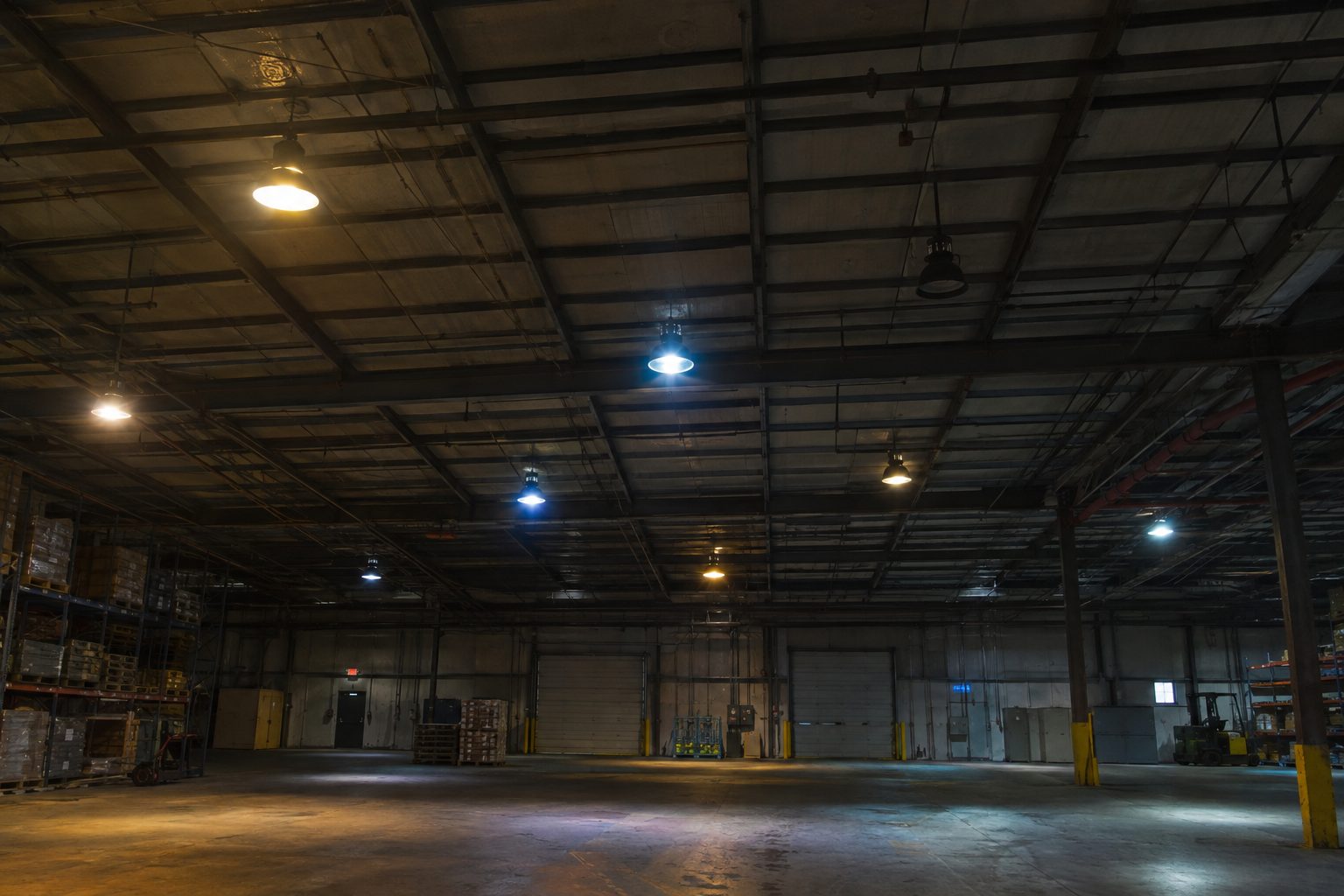
LED systems rarely fail all at once. They wear out gradually, through several separate mechanisms, and the failures show up one fixture at a time. That’s exactly why the problem is easy to underestimate. Each mechanism leaves a measurable technical signature and carries a measurable cost, and together they make the reliability case for a planned replacement.
Driver wear: often the first thing to go
In the field, the electronics often fail before the LEDs do. DOE notes that driver failures and optical degradation can happen long before lumen depreciation ends a fixture’s life (U.S. DOE). Inside the driver, the electrolytic capacitor is typically the shortest-lived part (U.S. DOE).
Heat is what wears it out. A common rule of thumb says an electrolytic capacitor’s life doubles for every 10°C it runs below its rated temperature (Lighting Research Center) and is cut in half for every 10°C it runs hotter (U.S. DOE):
Capacitor life ≈ Rated life × 2^((Rated temperature − Operating temperature) ÷ 10°C)
As an output capacitor degrades, its capacitance drops and its equivalent series resistance (ESR) rises. That increases the ripple in the output current, which affects the power delivered to the LEDs (Lighting Research Center). In practice, that points to a few things:
- The thermal environment largely sets driver life. Based on that temperature relationship, you’d expect the fastest aging in high bays in hot air near the roof deck, fixtures in unconditioned warehouses, and designs with the driver mounted close to the LED heat sink.
- Failures tend to bunch up. Fixtures from the same installation share the same components and temperature history, so failure rates can climb across the whole population at roughly the same time.
- Rising ripple can show up as visible flicker before the driver fails outright.
Lumen depreciation and the limits of lifetime claims
LED lifetime is conventionally defined by light output. DOE recommends defining it as the point when half of a product population has dropped below 70% of initial output, often written as L70 at B50 (U.S. DOE, LED Luminaire Lifetime). Keep two things in mind when you evaluate an older system.
A TM-21 projection is capped at six times the length of the LM-80 test behind it. So a claim of 100,000 hours to L70 can’t be supported by 10,000 hours of test data (Illuminating Engineering Society).
TM-21 also describes only the LED components. Reliability of the whole fixture depends on the drive circuitry and secondary optics too, and the IES doesn’t support using LED lumen maintenance as the only measure of luminaire life (IES).
The result is that a 10- to 15-year-old system may still be running while delivering well under its design light level. In warehouses, loading docks, and parking areas, that affects visibility, picking accuracy, and how well security cameras can see.
Color shift
DOE research identifies chromaticity shift, a change in the color of the light over time, as a separate failure mode in LED products (U.S. DOE). Because fixtures run at different temperatures and age at different rates, their color can drift apart. Add years of spot replacements with newer units, and many facilities end up with a visible mix of color temperatures. It’s especially noticeable in retail, schools, healthcare, and offices.
Flicker, especially when dimmed
Flicker, or more precisely temporal light modulation, depends mostly on how the driver regulates current to the LEDs, and drivers from the first-generation era varied widely in how well they controlled it. IEEE 1789 sets frequency-dependent limits for percent modulation (percent flicker). DOE sums them up this way: multiply the flicker frequency by 0.08 for the low-risk limit, and by 0.03 for the no-observable-effect level (U.S. DOE). At 120 Hz, the typical flicker frequency on 60 Hz power in the U.S., that works out to:
Low-risk limit = 0.08 × 120 = 9.6% modulation; No-observable-effect level = 0.03 × 120 = 3.6% modulation
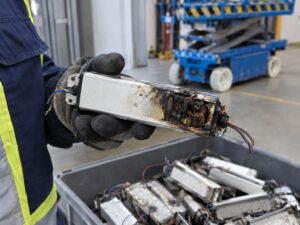
Dimming can make it worse. A DOE CALiPER evaluation published in 2013 found that one-third of the dedicated LED troffers it tested had 0–10 V dimming drivers that made the LEDs flicker when dimmed (U.S. DOE CALiPER). Those products came from the same era as many first-generation installations. It’s one reason adding controls to an existing first-generation system can give disappointing results.
The maintenance math
You can estimate the annual cost of repairing fixtures as they fail like this:
Annual maintenance cost = Number of luminaires × Annual failure rate × (Parts + Labor + Lift + Disruption cost per event)
Illustrative example: 200 fixtures, a 5% annual failure rate, and $300 per service call gives 200 × 0.05 × $300 = $3,000 a year, the same figure used in our business-case article. That number grows as the failure rate climbs later in the system’s life. Other costs are harder to spot in a budget:
- Parts obsolescence. Replacement drivers or modules for discontinued fixture lines may not be available anymore, which forces you to replace individual fixtures with something that doesn’t match.
- Excess energy. The old system still draws more power per lumen delivered than current equipment.
- Emergency calls in areas that can’t stay dark, such as egress paths, docks, and production lines.
- Liability exposure where light levels drop below what the task or code requires.
Planned group replacement vs. fixing fixtures as they fail
Replacing the whole system at once is often cheaper than repairing it piece by piece, because one mobilization takes the place of many separate lift rentals and service calls. It also resets the entire installation to one known age, one set of components, and one color. Pair it with redesigned photometry, dimming-capable drivers, and controls, and an unpredictable, rising maintenance cost becomes a single budgeted capital project.
Before you commit, check warranties. If the failing fixtures are still covered, a warranty claim may cost less than any of these options. Group replacement also isn’t always the better choice. For a small number of fixtures with low hours and available parts, spot repair can still be cheaper.
Incentives can widen the gap. Most commercial lighting rebate programs require DLC-listed equipment (LightNOW). Replacement drivers bought for spot repairs generally aren’t the qualified fixtures or retrofit kits those programs pay for, so a planned group replacement is usually how you capture the incentive. Check the rules for the program in your utility territory.
Signs a system is due
- Installed more than 10 years ago, or has run for more than roughly 50,000 hours (a practical rule of thumb, not a standard)
- Driver failures increasing year over year
- Visible color differences between neighboring fixtures
- Measured light levels below design at the task plane
- Visible flicker, especially when dimmed
- A discontinued fixture line, or replacement drivers you can no longer get
Next step
LED Sales Team can document your failure history, measure light levels and input power, and compare the cost of ongoing repairs with a planned group replacement. Contact us to schedule an assessment.